When the World Stops Working
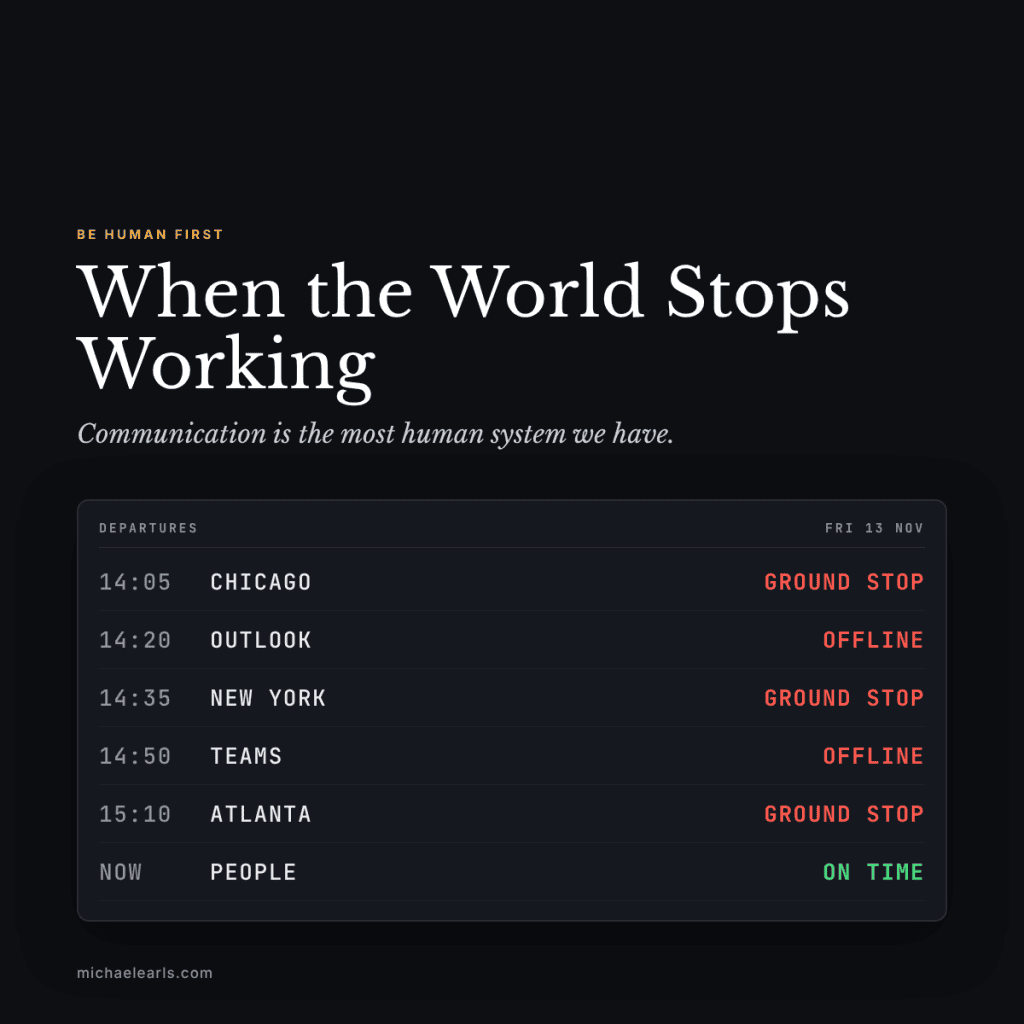
Two outages, one week, and a reminder that communication is the most human system we have.
This week the world stopped working. Twice.
First, Microsoft 365 went down for the better part of a day. Outlook went quiet. Teams went dark. The virtual office most of us live in simply wasn’t there. No calendar telling us where to be. No chat pinging us about what we missed. No inbox to hide in.
Then, Friday afternoon, the FAA issued a nationwide ground stop. Every departing flight in the country, held on the ground. If you’ve ever stood at a gate watching the board flip from “On Time” to “Delayed” to nothing at all, you know the feeling. Travel is already stressful. Now multiply it by every airport at once.
Here’s the part that made me stop and laugh, a little.
Microsoft’s status updates said the process on its servers that sets up secure connections, the handshake that lets its systems talk to each other, got overwhelmed after a network change. The FAA pointed to a communication issue across its air traffic control centers. Two very different worlds. The same root problem.
Something stopped talking to something else, and everything downstream stopped with it.
What did you do when the screens went quiet?
When Outlook and Teams went dark, I’d bet a lot of people did something they hadn’t done in a while. They picked up the phone. Actually called. Teams that hadn’t heard each other’s voices in weeks figured out what mattered and what could wait. Some people walked down the hall. Some just took a breath, maybe for the first time all week.
The tools went down. The work didn’t. People found each other.
And the airport? Last week at this exact time, I was flying home from Aruba, connecting through Atlanta. If the ground stop had hit seven days earlier, I’d have been sitting at a gate in Hartsfield-Jackson, watching the board go blank with everyone else. I know what happens next, because I’ve seen it. The strangers at the gate start talking. Someone shares a charger. Someone finds out who else is headed to Chicago and whether a rental car makes more sense. The gate agent, who is having the worst day of anyone in the building, gets a “thank you” instead of a complaint, if we’re paying attention.
I’ve stood in that line before. In The Digital Compass, I wrote about a two-hour TSA line during a partial government shutdown. Fewer agents, everything slowed down, and almost everyone head-down on their phones. One of the agents said something I won’t forget: “You’ve all been on your phones for two hours, and you still don’t know your gate.”
That line stuck with me because the problem wasn’t the wait. It was where we were while we waited. This week, the screens made the choice for us. Outlook was gone. The departure board was blank. And for a few hours, a lot of us did the thing that agent was asking for. We looked up.
The system behind the system
I’ve spent more than twenty years in infrastructure. I’ve built networks, designed data centers, and watched more than one outage unfold from the inside. Here’s what I’ve learned: we spend enormous energy making machines talk to each other reliably, and far less making sure people do.
We build redundant links, failover paths, and backup connectors. We test them. We monitor them around the clock.
But what’s our failover plan for people? When the tools disappear, do your teams know how to reach each other? Do they know what matters most? Do they trust each other enough to make a call without a ticket or a thread?
That’s not a technology question. It’s a leadership one.
Communication is the human protocol
Being radically human in a digital world doesn’t mean rejecting the tools. I love the tools. It means remembering that the tools carry our communication; they aren’t our communication.
When the machines stop talking, the people can’t.
So here’s my ask for the week ahead, outage or no outage:
- Call someone you usually only message.
- Tell your team what matters most this week, in plain words, before they have to guess.
- Be kind to the people on the front line when systems fail. The gate agent didn’t cause the ground stop. The help desk didn’t break the network.
- Ask yourself: if every screen went dark tomorrow, would your people still know where you’re headed?
Speed without direction is noise. And connection without communication is just a network.
When the world stops working, it’s the people who keep it human.
Be Human First.