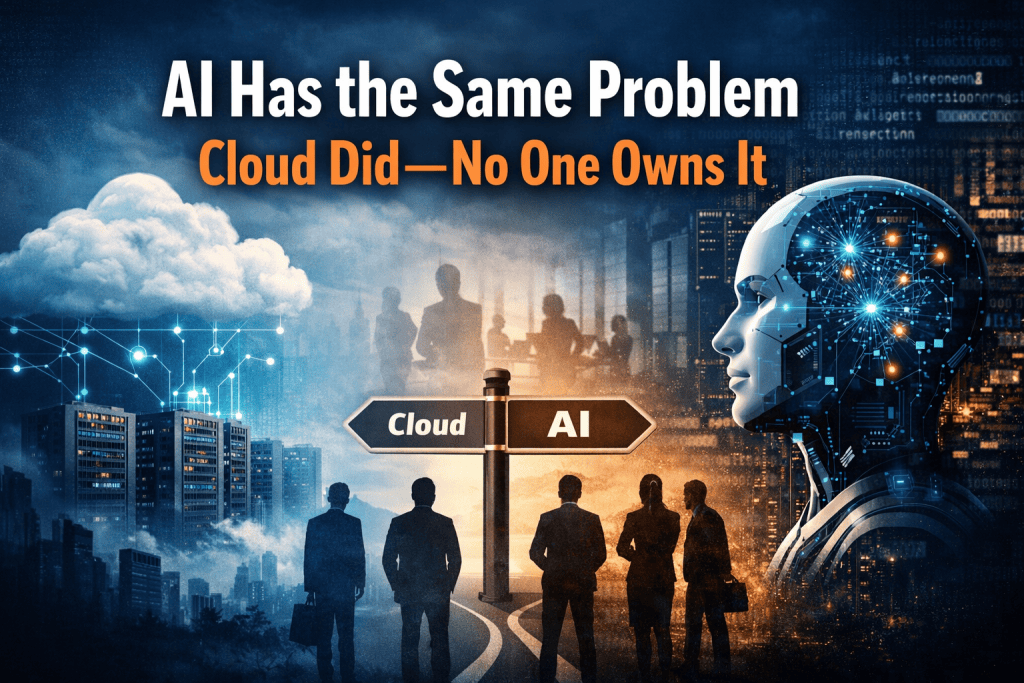
AI Has the Same Problem Cloud Did — No One Owns It
I read something this week that stuck with me.
The core idea was simple: no one is actually in charge of AI.
And the more I thought about it, the more familiar it felt. Because we’ve seen this before.
I’ve been part of the cloud journey for a long time. I’ve seen the early adopters go all in—moving fast, embracing the shift, and figuring things out as they went. I’ve also seen the late adopters, who took a more measured approach, trying to align budgets, operating models, and long-term strategy before fully committing.
But regardless of timing, the pattern was often the same.
Ownership was never clear.
Was cloud an IT decision? A finance model? An engineering shift? A business transformation? In most organizations, it became a little bit of everything—and because of that, it was never fully owned by anyone.
So we defaulted to what was easiest.
Lift and shift.
Move the workloads. Stabilize the environment. Call it progress.
And for a while, it worked.
Systems were running. Applications were in the cloud. The organization could point to progress. But underneath, very little had actually changed. The same systems, the same dependencies, and the same operational friction were still there—just running somewhere else.
That’s where things started to stall.
AI is following the exact same path.
Everyone is experimenting. Every team is testing tools. Every vendor has a story. The pace is faster, the visibility is higher, and the expectations are bigger. But when you step back and ask a simple question—who actually owns AI in your organization—the answer is usually unclear.
And that’s the problem.
Because when no one owns it, everyone touches it, but no one transforms with it.
The real failure of AI isn’t the technology. It’s the organization around it.
What I’m seeing right now is a familiar pattern. AI often sits in innovation teams or pilot programs. IT manages infrastructure and access. Business units experiment with use cases. Finance tries to understand the cost implications. But no one owns how it all comes together into a coherent operating model.
So activity increases. Complexity increases. But outcomes don’t change.
We’ve seen this before.
Cloud created the illusion that movement equals progress. AI is now doing the same thing. More pilots, more tools, more experimentation—but without ownership and alignment, it doesn’t translate into transformation.
Because if AI isn’t integrated into workflows, connected to real decisions, and embedded into how work actually gets done, it becomes just another layer of technology.
Not a transformation.
The organizations that will get this right will approach it differently. They won’t treat AI as a tool or a feature. They’ll treat it as an operating model decision. That means clear ownership, cross-functional alignment, and a direct connection between data, decisions, and outcomes.
Cloud taught us something important. Moving fast doesn’t mean you’ve changed anything. It just means you’ve moved.
AI is forcing the next step.
Not where things run, but how things work.
And that’s the part most organizations haven’t fully figured out yet.
Cloud exposed inefficiencies. AI is exposing ownership.
And the organizations that win won’t be the ones with the most tools or the fastest pilots. They’ll be the ones that can answer one question clearly:
Who’s actually in charge?
Closing
This is something I’ve been thinking about a lot—especially as AI continues to accelerate everything around us. Technology is moving fast, but the system around it still determines whether it actually matters.