
Ten Minutes or Ten Thousand Hours
“Steve Jobs ruined everything with the iPhone.”
That’s Palmer Luckey, the Oculus inventor and Anduril cofounder, talking to Walter Isaacson on Isaacson’s podcast, The Builders. Fortune wrote it up this week. His argument: the iPhone made technology so easy that you can learn it in a minute and master it in ten, and then you hit the ceiling. And now everything is built that way. Every app. Every device. Every headset.
“There is no provision made for the man who will spend 1,000 hours, 10,000 hours, 50,000 hours learning his art.”
Palmer Luckey
I don’t think easy is the enemy. Easy lets people in. But that line stuck with me, because I’ve watched three men in my life spend those hours. And I spent some of my own.
Five days to paint one room
My father went from selling insurance to building everything by hand. Measure twice, cut once. Everything was to perfection.
I remember working for him. It would take five days to paint one room. Why five days? Some people come in and paint over. Not him.
Everything came off the wall first. The outlet covers, the light switches, the nails. Each one labeled and set aside so it went back in the same spot. We sanded every wall down and looked for changes in the drywall. We fixed the drywall. Then we slowly worked our way back, filling every hole in the baseboard and the molding, caulking the windows, the frames, the doors. By the time the fifth day came around, we would paint. Let it sit 24 hours. Paint again. Then put everything back where we labeled it.
Nobody would have noticed if we skipped a step. He would have.
“I went off the GPS”
My father-in-law, Jerry, runs an excavation company. I’ve never seen a man be so good at what he does.
The first time I watched him, I said, “Hey, I can do that. It’s just a joystick.”
It is not just a joystick. Jerry can knock the cap off a beer bottle with one of his machines and not crack the glass. He can work upside down, sideways, slantways. He knows how the grade works, what kind of stone goes where, how to read the maps. Every one of those things is hours. Thousands of them.
He talks about the young operators now, where everything is GPS-enabled. On one job, the grade went from 1 foot to 10 feet. Jerry asked the kid running the machine, “Did you not notice the difference in the grade?”
“I went off the GPS.”
Jerry can feel it. He knows it. The kid trusted the screen over the ground under his own seat, because nobody ever asked him to learn the ground.
The right questions
My stepdad, Skip. No better man.
He has two degrees, one in electrical engineering and one in internal medicine. He knows the electrical side of your body and the medical side of your body. He has spent his career perfecting the craft of diagnosing and treating patients, and other doctors consult him on patients that aren’t even his.
What makes him good isn’t that he has the answers. It’s that he knows the right questions to ask. Not AI-generated questions. Questions that come from understanding how the human body works and how medicine affects it, built up one patient at a time, as much art as science.
From cables to data centers
And then I look at myself.
I started as a junior engineer learning how to make cables. My mentor, Paul, taught me to crimp the ends and to read every line of a router config before he’d show me the shortcut codes. Then he left me alone at a customer site. I ran the cable, built the ends, got the router and switch up. No lights. I had made a crossover cable by mistake. Which end do I fix? I redid both ends.
From there it was switches, then compute and storage, then designing large-scale data centers, physical layout to virtual layout, and learning how interconnections and routing protocols actually work. I paid for a two-week boot camp out of my own pocket to get my CCNP. Each step carried the next one.
You don’t see that path much anymore.
On by default
We’ve turned into a simplified world of point-and-click, where everything is on by default. There’s no mastering. The tool decides, and we confirm.
To be fair to the other side, Fortune points out that the productivity slowdown Luckey blames on the iPhone actually started around 2004, before it existed. Easy products sell because people want them, and easy lets more people in. That’s a good thing.
But the same article cites a study of customer support agents using generative AI. The biggest gains went to the beginners. The experts barely moved. AI raises the floor faster than anything we’ve built. The question nobody is answering is what happens to the ceiling. If the tool does the hard part, who is still putting in the 1,000 hours? Who will feel the grade when the GPS is wrong?
Here’s what I keep coming back to: when somebody else optimizes your world, you become less and less of an expert in it.
Why did I take the long way?
I’ve been asking myself that this week. Why did I turn that way? What was the value behind it? What changed?
Part of the answer is that I didn’t have a choice. There was no shortcut code until Paul decided I’d earned it. But the bigger part is the people. My father, Jerry, and Skip never told me mastery mattered. They just did the work in front of me, the slow way, until I couldn’t unsee it.
That’s the part I worry about. Not that the tools are easy. That the people who would have shown us the long way are being optimized out of the room.
So if you lead people, put your juniors next to your Jerrys. Let them watch someone feel the grade. Let them redo both ends of a cable. Make room for the hours, even when the tool says you don’t need them.
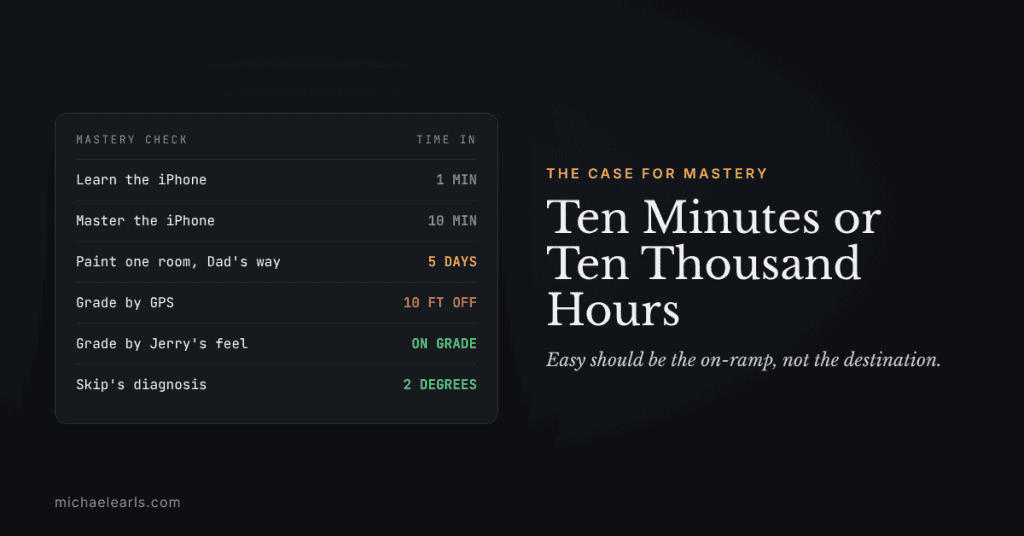
Easy should be the on-ramp, not the destination.
Who taught you what 10,000 hours looks like?
Be Human First.