The Company You Keep: On My First Book Making Tim Hughes’ Executive Bookshelf
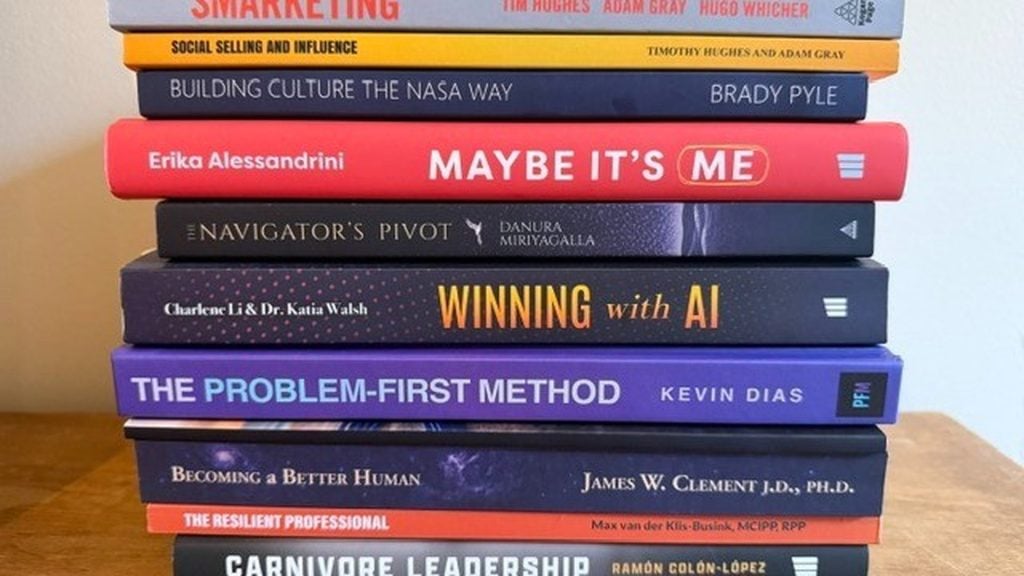
There is a photograph I have looked at more times than I care to admit today.
It is a stack of ten books, spines out, sitting on a wooden shelf. Somewhere in the middle is my very first book — Finding Direction in the Age of AI.
Tim Hughes — one of the most respected voices in modern leadership and the founder of DLA ignite — just published his Executive Bookshelf: a curated review of ten authors he believes are shaping the way executives think about business, technology, and being human at work.
That book is on the list.
Why the first one hits different
Every author who has written more than one book will tell you the same thing: the first one is the one you were most sure would fail.
Finding Direction in the Age of AI was written before the market had settled on what “AI leadership” even meant. I wrote it because I could not find the book I needed to read, and I figured other leaders were probably in the same position. There was no roadmap. There were no reviews to worry about. There was just an idea I could not put down.
The book that followed — The Digital Compass: Finding Direction When Everything Moves Too Fast — was built on the foundation that first book laid. Every framework, every metaphor, every question I keep coming back to started there.
So when a leader like Tim Hughes reaches into a shelf full of options and pulls out the first one — the one I wrote before I knew what I was doing — that is a moment worth stopping for.
The first book is where the voice was still forming. To see it hold up years later, on a list like this, is the kind of quiet validation you cannot manufacture.
Who else is on that shelf
To be included is one thing. To be included in this specific company is something else entirely.
The list reads like a who’s who of people I have quietly learned from for years:
- Brady Pyle — Building Culture the NASA Way. A leader who helped shape culture inside one of the most consequential organizations in modern history.
- Charlene Li and Dr. Katia Walsh — Winning with AI. Charlene has been a north star on digital disruption for over a decade. Getting shelf space next to her work is not something I take lightly.
- Kevin Dias — The Problem-First Method. A rigorous approach to solving what actually matters instead of what is loud.
- Ramón “CZ” Colón-López — Carnivore Leadership. Ramón served as the Senior Enlisted Advisor to the Chairman of the Joint Chiefs of Staff. His perspective on leadership under pressure is not theoretical.
- James W. Clement, JD — Becoming a Better Human. Bridging longevity science and personal transformation.
- Max van der Klis-Busink — The Resilient Professional. On sustainable performance in careers built to last.
- Erika Alessandrini — Maybe It’s Me. On the honest, uncomfortable work of self-leadership.
- Danura Miriyagalla — The Navigator’s Pivot. On leading through transition.
- Timothy Hughes, Adam Gray, and Hugo Whicher — Smarketing / Social Selling and Influence. The playbook that has quietly rewritten how B2B works.
These are not similar books. That is the point.
Tim did not curate a genre. He curated a set of voices he believes are moving the conversation forward — in leadership, in AI, in health, in resilience, in culture. The through-line is not topic. It is intent.
What this actually means to me
There is a version of author life that measures success by rankings, review counts, and Amazon dashboards. I have chased that version. It is exhausting and, more importantly, it is the wrong measurement.
The measurement that matters is much simpler:
Are the right people reading this? And is it changing anything?
Being named to a list like this answers both questions in a way no algorithm ever could. Tim Hughes reads carefully. He does not include books to be nice. And the audience he curates for — executives navigating the intersection of humanity, technology, and change — is exactly the audience I was writing for when I started, back when I was not yet sure I had permission to write for them at all.
If Finding Direction in the Age of AI is on a shelf next to Charlene Li and a former Senior Enlisted Advisor to the Joint Chiefs, then the ideas that made me start writing in the first place are in the conversation I hoped they would enter.
That is not vanity. That is signal.
The one theme running through the shelf
I read the descriptions of every book on the list this morning.
Different fields. Different backgrounds. Different formats. But one theme kept surfacing:
The people writing the books that matter right now are not trying to make you faster. They are trying to make you clearer.
Clearer about culture. Clearer about decisions. Clearer about your own health, your own leadership, your own reasons for doing what you do.
That was the animating question of my first book, and it has been the through-line of every book since. In a world obsessed with acceleration, the most subversive thing a leader can do is stop long enough to know where they are actually going.
Tim’s shelf, taken as a whole, is a quiet argument that clarity is the new competitive advantage.
I could not agree more.
For anyone with a first book still in a drawer
If you are reading this and you have a first book you have not finished — or have not started — I want you to hear something plainly.
You will not know if it matters until you send it out. You will not know if the right people will find it until they do. And you cannot manufacture the moment when a leader you respect pulls your book off a shelf and hands it to their community.
You can only write the book that is honest and useful and let it live.
Mine took years to find its people. Some of them, it turns out, run companies I have admired from a distance for a decade.
The company you keep, in the end, is decided by the work.
Thank you
To Tim Hughes — thank you for the read, the review, and the reminder that the best communities in this space are still built the old-fashioned way: one honest recommendation at a time.
To everyone else on that shelf — I have some new books to buy.
To the readers who picked up Finding Direction in the Age of AI back when it was just an unfamiliar cover from an unfamiliar author — you made every book that came after it possible. Thank you.
Read Tim Hughes’ full Executive Bookshelf roundup: The Executive Bookshelf: Critical Reviews of Today’s Top Business Minds
Grab a copy of Finding Direction in the Age of AI: Amazon
Or read what came next — The Digital Compass: Amazon
Explore the full library: Books by Michael Earls
Watch the TimTalk conversation with Tim Hughes: Direction Over Speed