The Brain on All-Day Video: Zoom Fatigue and Staying Human in a World of Endless Meetings

Why video meetings exhaust our brains and what research says about Zoom fatigue in the modern workplace.
A few years ago, the workday quietly changed. Meetings that once required walking down the hallway now take place on a screen. Instead of conference rooms, we sit in front of cameras. Instead of reading the room, we read a grid of faces on Zoom, Teams, or Webex. For many professionals, especially in technology, consulting, and sales, entire days now take place in video meetings. By the end of the day, something feels off. You are mentally exhausted, even though you barely moved.
Researchers now have a name for this experience: videoconference fatigue, also known as Zoom fatigue. Scientists studying the brain have found that video meetings require more mental effort than normal, in-person conversations. When we speak face to face, our brains automatically process body language, posture, subtle tone shifts, and spatial awareness. These cues help conversations flow naturally. On video calls, many of those signals are missing or distorted, so the brain has to work harder to interpret what people mean and how they are reacting. That extra effort increases cognitive load, which is the amount of mental energy required to process information.
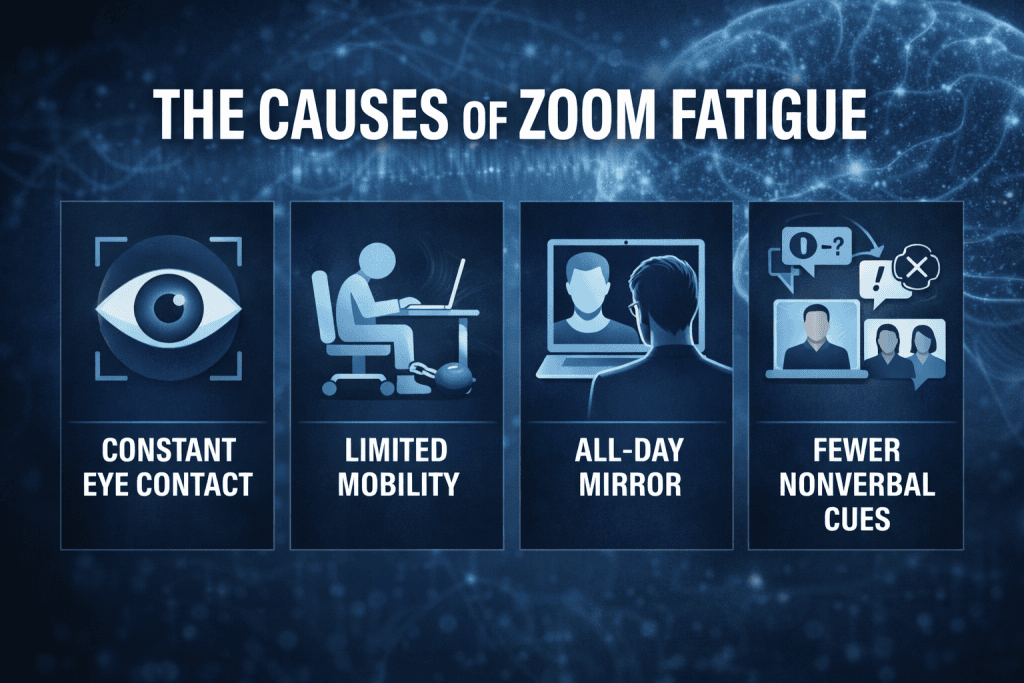
Another factor is something most people don’t even realize is happening. On video calls, we constantly see ourselves. In a normal conversation, we never stare at our own face while talking, but video meetings create a digital mirror that stays on the screen all day. Psychologists say this increases self-monitoring. Part of your brain is subtly evaluating posture, facial expressions, lighting, and appearance while you try to listen and contribute to the conversation. It is essentially like giving a presentation while watching yourself present, hour after hour.
Video meetings also create an unusual level of eye contact. In a real meeting room, eye contact naturally shifts as people look at slides, notes, or others around the table. On video calls, faces appear larger and closer to the camera, which creates a sense of more intense social interaction. Our brains interpret that level of eye contact as high-focus engagement, something usually reserved for smaller, more personal conversations. When that intensity continues across multiple meetings throughout the day, it quietly drains mental energy.
There is another piece that often goes unnoticed: movement. Before remote work and constant video meetings, the workday naturally included small physical transitions. People walked between conference rooms, grabbed coffee, or stopped to talk in the hallway. Those small moments mattered more than we realized. They gave the brain time to reset between conversations. Video meetings remove those transitions. One meeting ends, and another begins instantly, leaving no space for the mind to recover.
None of this means video meetings are bad. In many ways, they are remarkable tools that allow teams to collaborate across cities, countries, and time zones. But research is showing that the brain was never designed to communicate through a camera for eight hours straight. As work continues to evolve, organizations may need to rethink how meetings are structured. Shorter meetings, breaks between calls, and even walking phone calls can help restore a healthier rhythm to the workday.
Sometimes I also notice something else that feels strange in this new world of work. When my phone rings and it is a colleague or a customer, my first reaction is almost confusion. Why are they calling my cell phone? I assume we’ll jump on a Teams or Zoom meeting. The idea of just talking on the phone almost feels unusual now.
I wake up many mornings with my eyes exhausted. I mentioned it to my doctor, and he checked everything. His response was simple: ” Your eyes are fine, you actually have great vision. Then he asked a few questions. Do you sleep well? Do you stare at a computer screen all day? My answer was simple and a little funny when I said it out loud: I talk to my computer all day.
Our meetings have evolved. Communication has evolved. In many ways, we are living in the era of the Jetsons, where video calls are the norm. Yet part of me still remembers when the phone was attached to the wall. There was a physical cord attached to it, which created a natural boundary. You could walk across the room, but you could not take it out of the house. Technology stayed in its place.
Today, technology follows us everywhere. Our meetings are in our pockets, on our laptops, on our watches, and on every screen around us. We have evolved alongside the technology.
Yet many of us still ask the same question: why do we feel so tired? Why do we feel drained in the middle of the day and completely spent by the end of it? Why does Tuesday sometimes feel like Friday, and Friday feel like it is three weeks away from Monday?
Maybe the answer is simpler than we think. Our technology has evolved faster than our human rhythms. And somewhere in between those two worlds, we are all still trying to find the balance.
Key Takeaways
• Researchers now describe the mental exhaustion from video meetings as video fatigue or Zoom fatigue.
• The brain works harder during video calls because it must interpret fewer social cues while maintaining constant attention.
• Continuous eye contact on camera creates an unnatural level of social intensity that drains mental energy.
• Seeing yourself on screen all day creates the “all-day mirror effect,” increasing self-monitoring and cognitive load.
• Back-to-back video meetings remove the natural movement and breaks that once existed between meetings.
• Technology has evolved faster than our human rhythms, leaving many professionals mentally exhausted even when they have barely moved.
Scientific Research on Video Meeting Fatigue
- Bailenson, Jeremy N. (Stanford University).Nonverbal Overload: A Theoretical Argument for the Causes of Zoom Fatigue.Technology, Mind, and Behavior (2021).https://vhil.stanford.edu/sites/g/files/sbiybj29011/files/media/file/bailenson-apa-nonverbal-overload.pdfThis foundational paper explains how constant eye contact, reduced mobility, and the “all-day mirror” effect contribute to video meeting fatigue.
- Riedl, René et al. (2023).Videoconference Fatigue from a Neurophysiological Perspective: Experimental Evidence Based on EEG and ECG.Scientific Reports (Nature).https://www.nature.com/articles/s41598-023-45374-yThis study used brainwave and heart-rate monitoring to show that videoconferencing produces measurable fatigue at a neurological and physiological level.
- Fauville, G., Luo, M., Queiroz, A.C.M., Bailenson, J.N., Hancock, J. (2021).Zoom Exhaustion & Fatigue Scale (ZEF Scale).Computers in Human Behavior Reports.https://www.sciencedirect.com/science/article/pii/S2451958821000671Researchers developed a standardized scale to measure five forms of fatigue from video meetings: visual, social, motivational, emotional, and general fatigue.
- Girardi, D. et al. (2026).Videoconference Fatigue and Psychophysical Strain in Remote Work.ScienceDirect.https://www.sciencedirect.com/science/article/pii/S0001691825013344Research examining how video meeting fatigue contributes to work stress and psychological strain in modern remote work environments.
- Webb, M. (2021).Zoom Fatigue and How to Prevent It.National Library of Medicine / PMC.https://pmc.ncbi.nlm.nih.gov/articles/PMC10198405/Overview of physical and psychological responses associated with extended videoconferencing use.