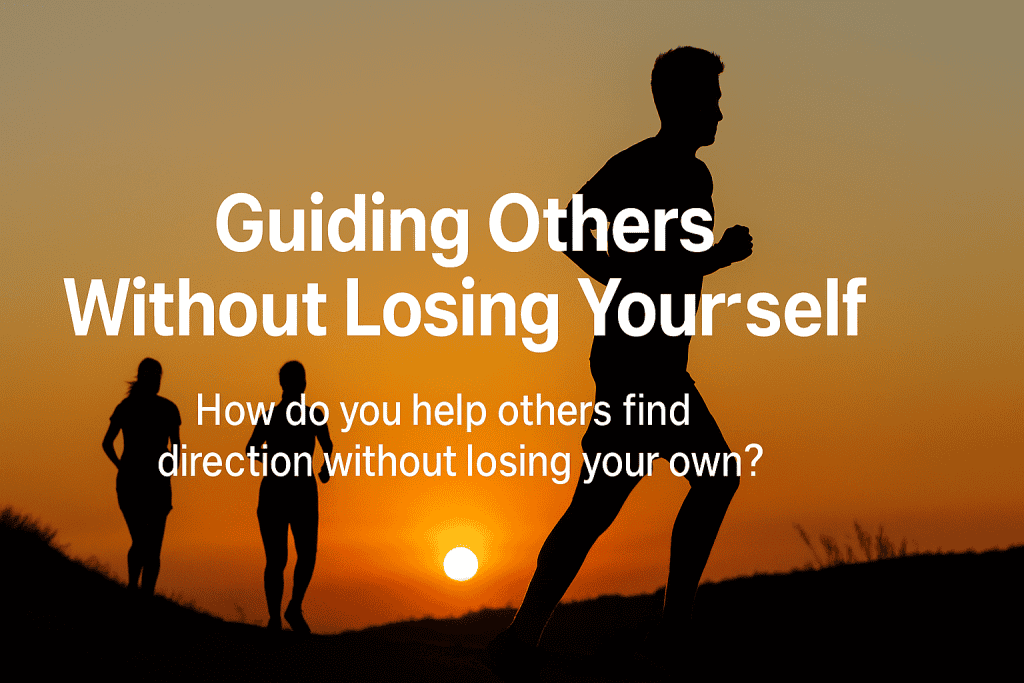
Guiding Others Without Losing Yourself
Leadership: A Journey of Balance
Over the past week, we’ve discussed finding direction and recalibrating our compass when life shifts. Both are inward journeys — learning how to listen, reflect, and realign.
I want to turn the compass outward. Because leadership isn’t just about following your own North Star — it’s about helping others find theirs without losing sight of your own.
The Story
Over the weekend, I was listening to a podcast on digital leadership. The speaker said something that stuck with me:
“Leaders don’t hand people maps. They teach them how to navigate.”
That line hit hard. In a world overflowing with directions, advice, and endless “how-to” guides, what people need most isn’t another set of steps — they need clarity. They need someone who can model how to navigate uncertainty with purpose and confidence.
That’s the role of a true leader: guide, don’t dictate.
It’s like pacing someone during a long run. You don’t drag them to the finish line — you match their rhythm, adjust when they struggle, and remind them that forward is still forward.
In my own career, I’ve learned this the hard way. Early on, I thought leadership meant steering the ship with confidence — having all the answers. Now I know it’s more about staying steady in the waves, creating space for others to find their footing, even as you adjust your own course.
Because if your compass isn’t calibrated, you can’t help anyone else find theirs.
The Framework: Leading with a Shared Compass
- Model clarity.
- When your direction is clear, others can align without confusion. Your consistency becomes the team’s compass.
- Encourage autonomy.
- Let others chart their paths within shared goals. Give them permission to explore, fail, and recalibrate — just as you do.
- Check alignment often.
- Great teams recalibrate together. Schedule pauses to reflect not only on progress, but direction. Sometimes the most significant leadership moment is asking, “Are we still headed where we meant to go?”
- Protect your own compass.
- Leadership can pull you off course if you’re not careful. Protect time to think, to reset, to return to your own purpose — so your guidance stays authentic.
The Bigger Picture
Guiding others doesn’t mean losing yourself. It means staying so grounded in your own values that others feel steady walking beside you.
When your compass is aligned, your leadership becomes magnetic. People don’t follow your title — they follow your example.
A true leader doesn’t just move people forward — they help them find their own north.
Goals and Next Steps
- Reflect: Ask yourself — am I leading with clarity or control?
- Recenter: Revisit your own purpose statement this week. Is it still true to where you are?
- Reconnect: Have one conversation with a teammate or peer about their “north.” Listen more than you speak.
The Reflection
Over the past few weeks, writing about direction has reminded me of something simple but powerful:
You can’t lead others well until you’ve learned to lead yourself.
That’s the evolution — from self-awareness, to calibration, to shared clarity.
Question for you:
How do you help others find direction without losing your own?