Single-Cloud First: Discipline, Not Dogma
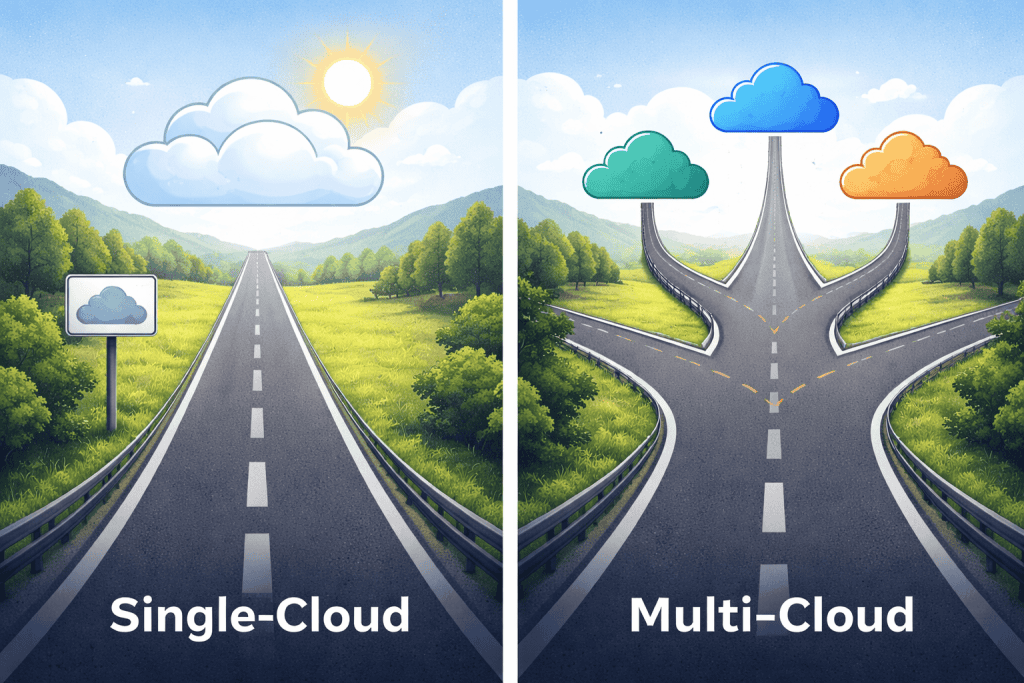
Cloud conversations often frame single-cloud and multi-cloud as opposing strategies.
One sounds flexible.
The other sounds limiting.
But that framing misses the point.
Single-cloud first isn’t about loyalty. It’s about discipline. And discipline is what makes control possible.
Most environments don’t start as multi-cloud. They gradually become multi-cloud: a SaaS platform here, a new workload there, an acquisition, a special requirement, a team that needed something “right now.”
Each decision makes sense locally. Over time, the environment becomes globally complex.
More providers.
More identity domains.
More platform differences.
More places where “temporary” decisions become permanent architecture.
Eventually, teams aren’t managing cloud strategy. They’re managing variance. That’s where discipline comes in. Single-cloud first doesn’t mean “only one cloud forever.” It means the default assumption is consolidation, not expansion. It means new platforms are exceptions, not starting points. It means you exhaust the capabilities of one environment before introducing the operational cost of another.
Because every additional cloud multiplies three things: Identity boundaries, Platform surface area, and Operational cognitive load. None of those scales is linear. The argument for multi-cloud usually sounds like resilience, leverage, or flexibility.
But resilience without clarity becomes fragility. Leverage without alignment becomes complexity. Flexibility without guardrails becomes drift.
Single-cloud first is about establishing operational coherence, shared patterns, shared identity context, and shared platform assumptions. It creates a stable baseline from which exceptions can be understood and governed.
Without that baseline, everything feels like a one-off. I’ve had this conversation many times with clients, peers, and friends.
The question usually sounds technical at first:
“When do we add another provider?”
“Is this workload better somewhere else?”
“How do we bring this into the same management plane?”
But the real discussion doesn’t stay technical for long.
When we slow the conversation down, it always starts the same way:
What are we actually trying to solve, and why?
What is the business problem?
What is the technical problem?
Those questions change the room. Because the final question I always ask is this: Do we truly need another product or provider added to the bag? Or have we not exhausted what we already have?
Most of the time, it’s not a product gap. It’s a timing issue. A new initiative, a new team, a new deadline. Something urgent appears, and adding a provider feels like progress because it’s visible and decisive.
That’s when whiteboards and Post-it notes come out. Conversations shift from architecture diagrams to event-storming sessions. We trace what actually happened, what triggered the decision, and the original constraint.
And that’s where things usually get clear. The root of the problem is almost never technology.
It’s a business decision — speed, acquisition, market timing, a new line of business — that drove a technical choice before operational discipline had time to catch up.
Single-cloud discipline doesn’t fight business growth. It gives it structure. It forces us to pause long enough to ask whether we’re solving the right problem, or just choosing a visible solution.
Because once a provider is added, the decision becomes architecture — and architecture lingers long after the urgency fades.
This ties directly back to the earlier pieces in the series.
Expert Mode showed how speed creates complexity.
Identity First showed where authority lives.
Platform First showed how work is shaped.
Agentic AI showed how autonomy amplifies everything.
Single-cloud discipline asks a simpler question:
Do we have enough internal coherence to expand without losing clarity?
Single-cloud first doesn’t reject multi-cloud.
It prepares you for it. It creates a system where:
- Identity patterns are mature
- Platform guardrails are proven
- Operational practices are repeatable
Only then does expansion become additive instead of destabilizing.
When you add a new cloud, does your architecture get stronger, or just more complicated?
This post builds on earlier essays: Expert Mode, Identity First, Platform First, and Platform First, and Agentic AI.