Want to Get Smarter? Get Moving.
There’s a fascinating idea that keeps popping up in both neuroscience and high-performance circles:
If you want to get smarter, don’t just sit there—move.
In a recent article by Jeff Haden for Inc., he breaks down the science behind intelligence and adaptability. The TL;DR? Mental agility isn’t just about what you think—it’s about how you live.
It’s one more reminder that the best tools in our productivity stack aren’t always digital. Sometimes, they’re physical.
Let’s dig in.
The Power of “Chunking” and Why Variety Matters
According to neuroscience, one of the most effective ways to retain knowledge and grow your mental model of the world is chunking—organizing experiences, facts, and patterns into usable frameworks.
But you can’t build those frameworks without raw material. That means:
- Taking on new challenges
- Learning new skills
- Meeting new people
- Experimenting with new systems
Sound familiar? That’s exactly what we’ve been building on in past articles:
- Trying new workflows (like “Action Now / Action Later” inbox triage)
- Setting routines with music as a performance cue
- Reclaiming time through 168-hour planning
- Using AI tools like Copilot to manage email follow-up and context switching
The more varied and intentional your experiences, the richer your mental playbook becomes. And the easier it is to spot patterns, make decisions, and stay mentally agile.
Movement Fuels Intelligence
This isn’t self-help fluff. It’s hard neuroscience.
Physical activity promotes brain plasticity, improves memory retention, and increases dopamine levels—all of which support sharper thinking. Haden puts it simply:
“If you want to get smarter, get moving.”
That’s why movement is part of my daily stack.
- Morning workouts at Orangetheory or Body Alive
- Walks between meetings
- Stretch breaks during focused deep work
- Standing desk + music + Copilot = full engagement
And let’s be real: moving your body resets your brain. It clears mental fog. It interrupts the doom scroll. It brings you back into the workday with clarity.
Healthy Body, Smarter Mind
We talk a lot about brainpower and performance—but often skip over the basics: hydration, clean fuel, solid sleep. The truth? A healthy lifestyle is a tech stack upgrade for your brain.
The Inc. article doesn’t dance around it:
What’s good for your body is good for your mind.
And this doesn’t mean going full athlete mode. It just means prioritizing consistency over complexity:
- Daily movement (even 20 minutes)
- Nutritious meals and hydration
- Digital boundaries (close the laptop when the day ends)
- Replacing screen time with actual sleep
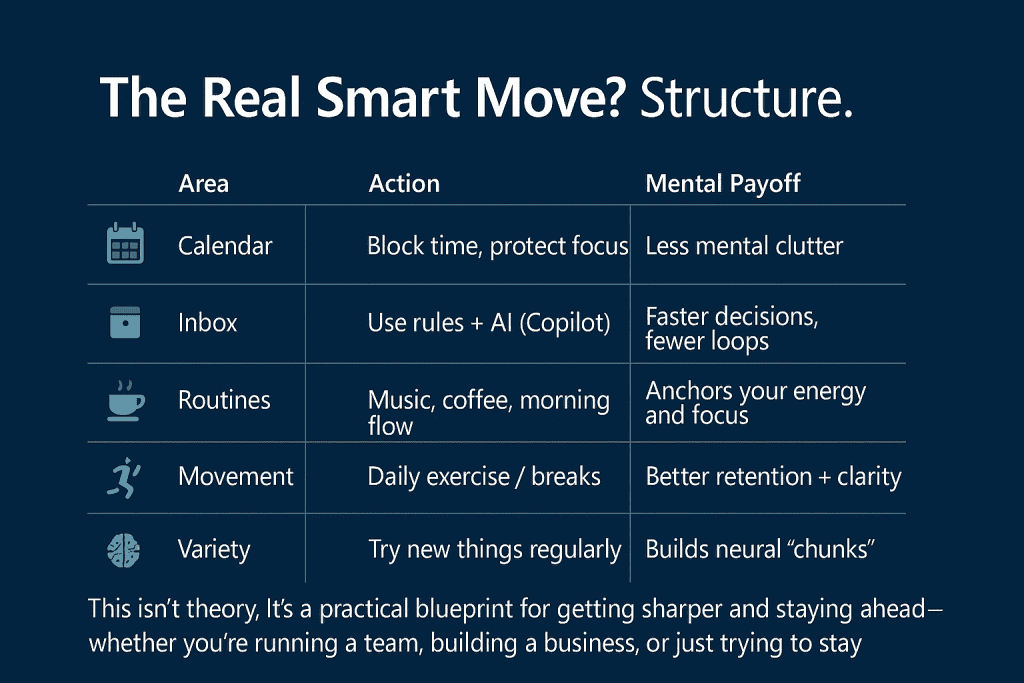
The Real Smart Move? Structure.
Let’s tie this together with what we’ve been building toward:
| Area | Action | Mental Payoff |
|---|---|---|
| Calendar | Block time, protect focus | Less mental clutter |
| Inbox | Use rules + AI (Copilot) | Faster decisions, fewer loops |
| Routines | Music, coffee, morning flow | Anchors your energy and focus |
| Movement | Daily exercise / breaks | Better retention + clarity |
| Variety | Try new things regularly | Builds neural “chunks” |
This isn’t theory. It’s a practical blueprint for getting sharper and staying ahead—whether you’re running a team, building a business, or just trying to stay energized through another high-output week.
Final Thought
We often look for smarter tools, smarter strategies, and smarter hacks.
But sometimes the smartest move is the simplest:
Move your body. Stretch your mind. Stick to your systems.
Smarter isn’t just a mindset.
It’s a lifestyle.
#Productivity #168Hours #TimeManagement #SmarterWork #Neuroscience #Mindset #MicrosoftCopilot #Wellbeing #AIAndYou #WorkLifeFlow #MichaelEarls